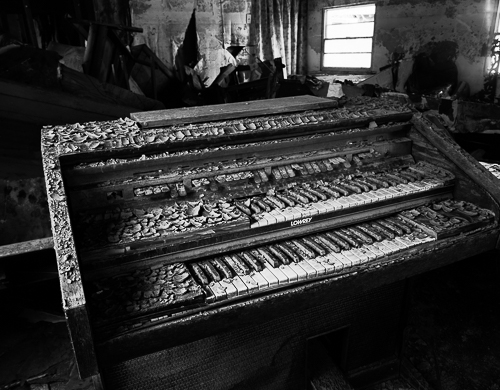
Most of my black and white work is done with a 4x5 view camera. The view camera movements allow me to control perspective and depth of field to better capture my vision of the final image. I used a Sinar F2 until summer 2009, when I switched to an Ebony 45SU. I use lenses ranging from an ultra-wide angle 47mm to a mild telephoto 300mm. If the subject is moving, or it is difficult to use a tripod, I use Linhof Technika IV press camera from the 1950s. It has a rangefinder and viewfinder that allows it to be focused and shot without a tripod.
I shoot Kodak Tmax black and white film. Until the fall of 2009, I used Tmax 100. I then switched to the new Tmax 400. This gives nearly as fine grain and sharpness as Tmax 100, with better shadow detail. It has less reciprocity failure in low light. This allows much shorter exposures in dark settings, reducing the chance of camera movement and making it easier to work when time is limited.
I process the film in a Jobo Expert Drum, rotated by an old Beseler developing tube roller. I use Xtol 1:3 and normal development for most negatives, but will pull or push development for extreme lighting situations. Once the negatives are dry, I scan them with a Canon 9950 flatbed scanner. I use Photoshop for negative adjustment and I use Lightroom as a filing system and to produce my WWW pages.
The color work, and the black and white of fast moving subjects, is done digitally. Most of my digital work is done with a Nikon D700, with some older images from a Canon Rebel XTi. As with the files from the scanned 4x5 negatives, the digital negatives are managed with Lightroom. Specific image processing is done with DXO to control lens aberrations and high ISO performance.
Prints are made with an Epson 3800 printer, using Epson UltraChrome inks. These pigment inks have a very long life and resist color shifts. The prints are made on fiber paper, primarily Epson Exhibition Fiber or Harmon Gloss FB. These are smooth surface papers that preserve fine image detail and very deep blacks. I personally make all prints. Prints are sold by the size of the paper. 8.5x11 prints have an approximate 7x9 image size, 13x19 prints have an approximate 11x14 image size, and 17x22 prints have an approximate 15x19 image size. These images sizes will vary with the aspect ratio of the print.
Prints are shipped by United States mail, using Priority Mail. Prints damaged in shipping with be promptly replaced at no charge. There is a basic $10 shipping and handling charge, with a $2 charge for each additional print.